ICD vs CPT Codes in Cosmetic Consultations: Z41.1, E/M and Modifiers
ICD-10-CM codes say why the patient came in; CPT says what was done. Z41.1 for cosmetic visits, functional diagnoses, E/M and modifiers 25, 59 and GY.
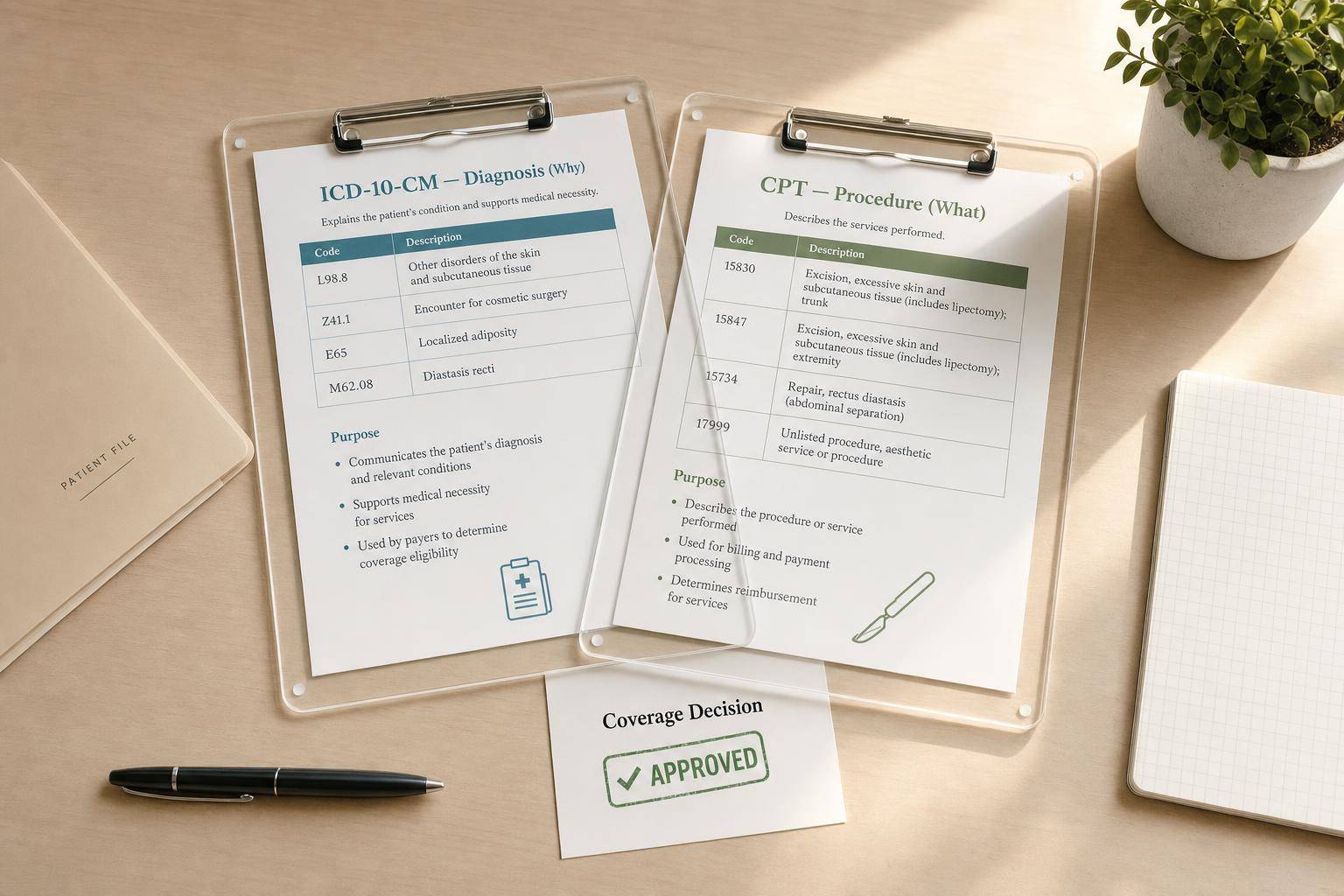

ICD-10-CM codes record why the patient came in; CPT codes record what the clinician did. In a purely cosmetic consultation, the reason for the visit is usually Z41.1 (encounter for cosmetic surgery, which includes cosmetic procedures), and the visit is normally self-pay because Medicare and most plans exclude cosmetic services. When the patient has a functional problem, the diagnosis is that problem, and the chart has to prove it.
- ICD-10-CM: the diagnosis or reason for the encounter. Maintained by CDC's National Center for Health Statistics; updated every October 1.
- CPT: the procedure or service performed, including E/M (evaluation and management) visits. Maintained by the American Medical Association; updated every January 1.
- Z41.1: encounter for cosmetic surgery (includes cosmetic procedure and cosmetic breast implant). Not reported with Z42.-.
- Z42.-: plastic and reconstructive surgery following a medical procedure or healed injury.
- Modifier 25: a significant, separately identifiable E/M service on the same day as a procedure.
- Modifier 59: a distinct procedural service, such as a different site or separate lesion.
- GY (Medicare): service statutorily excluded or not a Medicare benefit. An ABN is not required for it.
Sources checked October 14, 2026 · Prepared by Prospyr. No certified-coder or clinician review is claimed. CPT is a registered trademark of the American Medical Association; use the current licensed code set.
ICD and CPT side by side
| ICD-10-CM | CPT | |
|---|---|---|
| Answers | Why did the patient come in? | What was done? |
| Cosmetic example | Z41.1, encounter for cosmetic surgery | 15822, blepharoplasty, upper eyelid |
| Functional example | H02.831, dermatochalasis of right upper eyelid | 15823, blepharoplasty, upper eyelid, with excessive skin weighting down lid |
| Role on a claim | Supports whether the service is medically necessary | Describes the service being charged |
| Documentation focus | Complaint, history, findings, diagnosis | Procedure note, technique, time or medical decision making |
Diagnosis codes that can change the billing path
These diagnoses can make a procedure that is often cosmetic a candidate for coverage, if the record and the payer's policy support it:
| Condition | ICD-10-CM | Typical procedure context |
|---|---|---|
| Elective cosmetic encounter | Z41.1 | Appearance-only; self-pay |
| Deviated nasal septum | J34.2 | Septoplasty or septorhinoplasty for nasal obstruction |
| Hypertrophy of breast | N62 | Breast reduction |
| Dermatochalasis, upper eyelids | H02.831 (right), H02.834 (left) | Functional upper blepharoplasty with visual-field obstruction |
Note that the H02.83- subcategory also includes lower-eyelid and unspecified-eyelid codes (H02.832, H02.833, H02.835, H02.836, H02.839). Functional blepharoplasty policies are usually about upper lids, so pick the code that matches the documented eyelid.
A functional diagnosis needs objective support, such as visual-field testing, photographs or imaging, and documented conservative treatment where the policy asks for it. The diagnosis must reflect what the clinician found, not what would get the claim paid.
Reading about the problem? See how Prospyr solves it in one platform.
Book a DemoWhen is a consultation billable?
A purely cosmetic consultation is normally self-pay. When the consultation evaluates a medical problem, an E/M code may apply, selected by medical decision making or total time on the date of the encounter, under current CPT E/M guidelines.
If an E/M service and a procedure happen on the same day, the E/M is separately reportable only when it is significant and separately identifiable from the work included in the procedure (modifier 25). A routine pre-procedure assessment does not qualify. For example, an evaluation of a new rash before a scheduled biopsy of a different lesion may; consent and interval questions before a planned injection do not. See the modifier 25 answer.
For Original Medicare, cosmetic services are a statutory exclusion. GY marks a statutorily excluded service, and an Advance Beneficiary Notice is not required for it; CMS allows a voluntary notice, reported with GX. Cosmetic Botox for wrinkles is never billed with a therapeutic code; see Botox CPT codes.
Excision codes need the excised diameter
For benign (11400-11446) and malignant (11600-11646) excision codes, CPT instructs coders to use the excised diameter: the lesion's greatest clinical diameter plus the most narrow margins required. Record the lesion size, the margins and the site in the procedure note. Removing a benign lesion only for appearance is cosmetic.
Common mistakes
| Mistake | Likely result | Prevention |
|---|---|---|
| Diagnosis does not support the procedure | Medical-necessity denial | Confirm the documented diagnosis matches the service (for example, J34.2 with a septoplasty for obstruction) |
| Medical diagnosis on an appearance-only service | Audit risk, recoupment, possible false-claim exposure | Code what the record shows; use Z41.1 for cosmetic encounters |
| Unspecified code when a specific one is documented | Rejection or payer query | Use the most specific code the record supports |
| E/M level not supported by the note | Downcoding or denial | Tie the level to documented medical decision making or time |
| Outdated codes | Rejection | Load the new ICD-10-CM set each October 1 and CPT each January 1 |
A simple workflow for one visit
- Reason for visit. Record the complaint in specific terms. "Difficulty breathing through the nose" and "dislikes nasal profile" lead to different coding.
- Diagnosis. Assign the most specific ICD-10-CM code the clinician's findings support.
- Classify the encounter. Cosmetic (self-pay), medical (possibly covered), or both. If both, separate the documentation and the charges.
- Service. Choose the CPT code that matches what was done.
- Final check. Confirm the diagnosis and procedure are linked in the record, and that the patient knows in writing what they will pay.
Prospyr supports charting, digital intake, inventory and practice operations for aesthetic practices. It does not submit insurance claims or check code pairs; practices that bill insurance heavily need a separate claims solution.
Sources
- ICD-10-CM Z41.1, Encounter for cosmetic surgery (AAPC)
- CDC ICD-10-CM browser tool
- ICD-10-CM codes and official files (CMS)
- CPT code set overview (AMA)
- Medicare Benefit Policy Manual, Chapter 16, §120 Cosmetic Surgery (CMS)
- HCPCS modifier GY (Palmetto GBA)
- Advance Beneficiary Notice of Noncoverage (CMS)
- Blepharoplasty pre-claim review codes (Noridian JF Part B)
Free PDF guide + worksheets
Claims readiness workbook
Get the public answers and fillable review worksheets in one PDF. Save your own copy or print it for a team review. Use internal references only; keep patient information in your authorized clinical system.
- ✓ Sourced answers and practical examples
- ✓ Worksheets for your team to complete
- ✓ Official references and review prompts