CPT 15773, 11954 and Other Billing Codes for Aesthetic Practices (2025)
CPT 15773 is fat grafting to the face, eyelids, neck, hands or feet, 25 cc or less. Plus 11954, new 98000-98016 telemedicine codes and 2025 changes.
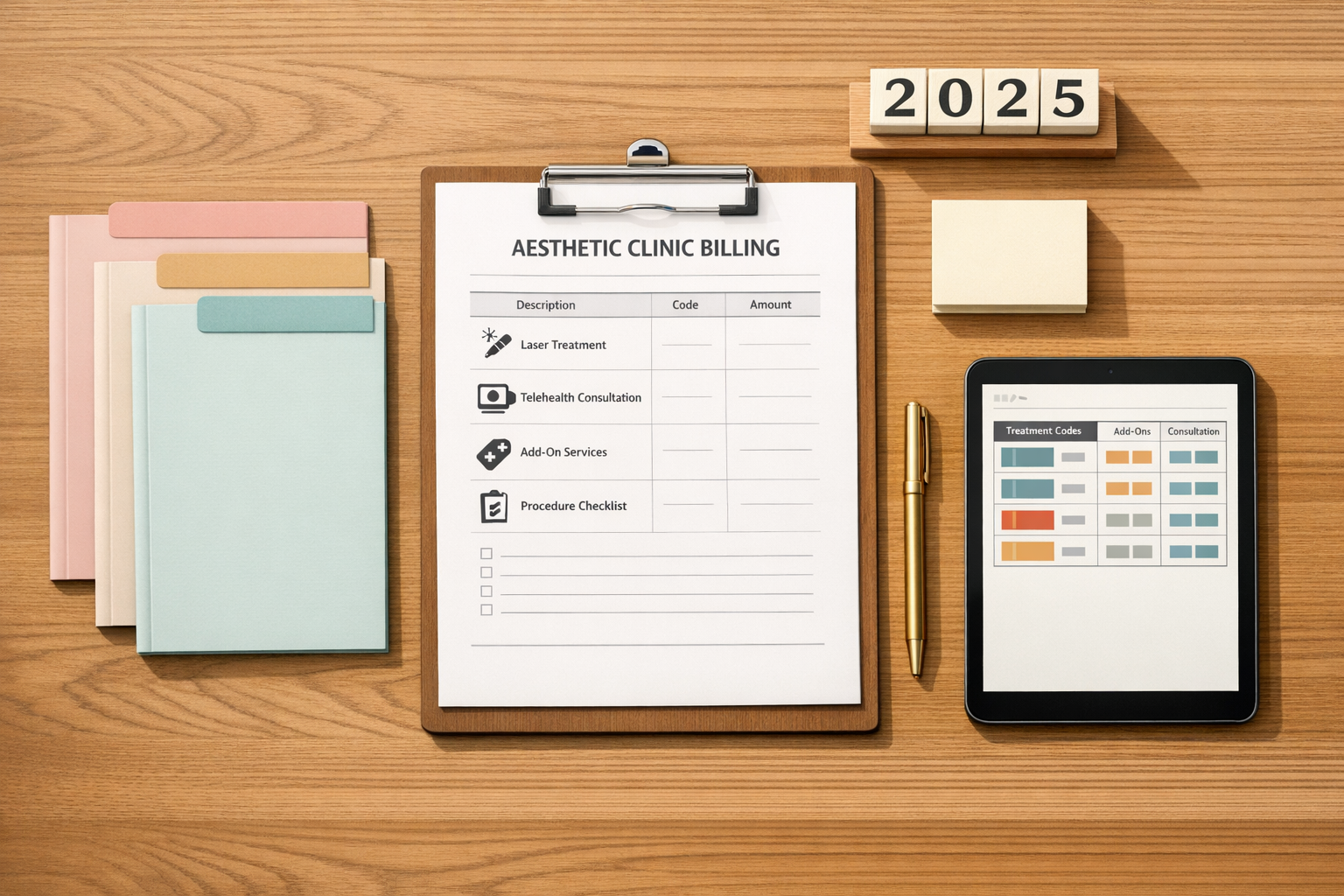

CPT 15773 is the code for grafting of autologous fat harvested by liposuction technique to the face, eyelids, mouth, neck, ears, orbits, genitalia, hands and/or feet, 25 cc or less of injectate. It is not a 2025 code: the fat-grafting family (15771-15774) took effect in 2020. CPT 11954 is not new either; it is subcutaneous injection of filling material (for example, collagen), over 10.0 cc. The codes aesthetic practices search for most, and what actually changed in 2025:
- 15773: autologous fat grafting (harvested by liposuction) to the face, eyelids, mouth, neck, ears, orbits, genitalia, hands and/or feet; 25 cc or less of injectate.
- +15774: add-on to 15773 for each additional 25 cc of injectate, or part thereof.
- 15771 / +15772: the same procedure to the trunk, breasts, scalp, arms and/or legs; 50 cc or less, and each additional 50 cc.
- 11950, 11951, 11952, 11954: subcutaneous injection of filling material (for example, collagen) by total volume: 1 cc or less, 1.1 to 5.0 cc, 5.1 to 10.0 cc, and over 10.0 cc.
- 98000-98015 (new for 2025): synchronous audio-video and audio-only telemedicine E/M visits, new and established patients. For example, 98008 is an audio-only visit for a new patient with straightforward medical decision making and more than 10 minutes of medical discussion (15 minutes or more when selected by time).
- 98016 (new for 2025): brief virtual check-in with an established patient (5-10 minutes of medical discussion). Medicare adopted it in place of HCPCS G2012.
- 15011-15018 (new for 2025): skin cell suspension autograft (harvest, preparation and application). These are burn and wound-reconstruction codes, not aesthetic ones.
Cosmetic filler and fat-grafting treatment is self-pay. Medicare does not cover cosmetic surgery; its one national coverage policy for dermal fillers is narrow (facial lipodystrophy syndrome in patients with HIV, billed with HCPCS G0429). Confirm any code against the current licensed CPT code set and the patient's plan before billing.
Sources checked October 14, 2026 · Prepared by Prospyr. No certified-coder or clinician review is claimed. CPT is a registered trademark of the American Medical Association; use the current licensed code set. This page covers the 2025 code year; the 2026 CPT code set is now in effect, so check for later changes.
What changed in CPT for 2025
The AMA's CPT 2025 code set made 420 changes: 270 new codes, 112 deletions and 38 revisions. Most new codes were proprietary laboratory analyses and Category III codes. Few changes affect aesthetic practices directly. The ones worth knowing:
New telemedicine E/M codes (98000-98016)
- 98000-98007: synchronous audio-video visits, new (98000-98003) and established (98004-98007) patients, by medical decision making or time.
- 98008-98015: synchronous audio-only visits, new (98008-98011) and established (98012-98015) patients. Audio-only codes require more than 10 minutes of medical discussion.
- 98016: brief communication technology-based service (virtual check-in) for an established patient.
- The telephone E/M codes 99441-99443 were deleted.
Medicare did not adopt 98000-98015. In the 2025 Physician Fee Schedule final rule, CMS said it would not recognize the new audio-video or audio-only codes for Medicare telehealth at this time. Medicare telehealth visits continue to use the office and outpatient E/M codes (99202-99215) with the place of service and modifiers CMS specifies. CMS did adopt 98016 in place of G2012. Commercial plans and Medicaid programs decide for themselves whether to accept 98000-98015, so check each payer's telehealth policy.
Skin cell suspension autograft (15011-15018)
These eight codes describe harvest (15011-15012), preparation (15013-15014) and application (15015-15018) of a skin cell suspension autograft, by area and anatomic site. They are used in burn and wound care, not in cosmetic treatment.
Codes that were not new in 2025
- 96920-96922 (laser treatment for inflammatory skin disease, psoriasis, by total area) are long-standing codes, not 2025 additions. For laser codes in general, see CPT codes for laser therapy.
- 11950-11954 and 15771-15774 were not added in 2025; they predate it. 11954 is a volume code (over 10.0 cc of subcutaneous filling material), not a "face and neck filler" code, and 15773 is a face, eyelid, neck and hands/feet fat-grafting code, not a body-contouring code.
- Botox coding did not split into new "cosmetic" and "therapeutic" codes in 2025. Cosmetic Botox is self-pay and is not billed with therapeutic codes; see Botox CPT codes.
Medicare payment changes for 2025
- Conversion factor: CMS finalized $32.3465 for 2025, down 2.83% from $33.2875 in 2024. Payment for any service also depends on its relative value units, geographic adjustment and setting.
- G2211 (office and outpatient E/M visit complexity add-on): payable since January 1, 2024. CMS describes it as capturing the complexity that comes from the longitudinal relationship: the practitioner is the continuing focal point for all needed health care services, or gives ongoing care for a single, serious condition or a complex condition. It is not a code for cosmetic consultations. Medicare does not pay G2211 when the E/M visit carries modifier 25, except (from January 1, 2025) when the same-day service is an annual wellness visit, vaccine administration or another Part B preventive service on CMS's list.
- Prolonged services: CPT 99417 is the prolonged office or other outpatient E/M code; 99418 is the prolonged inpatient or observation code. Medicare does not use 99417; it uses HCPCS G2212 for prolonged office and outpatient time, with a different time threshold.
Documentation that supports these codes
- Fat grafting (15771-15774): donor site, recipient site, and the volume of injectate. Add-on codes are counted per additional 25 cc (face and similar sites) or 50 cc (trunk and limbs).
- Filler injection (11950-11954): total volume injected in the session, the product, and the site.
- Telemedicine (98000-98016): modality (audio-video or audio-only), patient location, medical decision making or time, and minutes of medical discussion for audio-only visits.
- Any covered service: the diagnosis, the findings that support it and the payer's coverage criteria. A code that fits the service does not prove coverage.
Prospyr supports charting, digital intake, inventory and practice operations for aesthetic practices. It does not submit insurance claims; practices that bill insurance heavily need a separate claims solution.
Sources
- AMA releases CPT 2025 code set (AMA)
- CPT 15773 (AAPC)
- CPT 11954 (AAPC)
- Massachusetts administrative bulletin 20-38, 2020 added surgery codes including 15771-15774 (Mass.gov)
- CPT 98008 (AAPC)
- New 2025 telehealth CPT codes (SMFM)
- Skin cell suspension autograft code range 15011-15018 (AAPC)
- CY 2025 Medicare Physician Fee Schedule final rule fact sheet (CMS)
- 2025 conversion factor summary (American College of Radiology)
- MLN Matters MM13473: how to use G2211 (CMS)
- Prolonged services: 99417 versus G2212 (Find-A-Code)
- NCD 250.5, dermal injections for facial lipodystrophy syndrome (CMS)
- Medicare coverage: cosmetic surgery (Medicare.gov)