Telehealth Reimbursement Compliance Checklist (Medicare Rules Through 2027)
Telehealth reimbursement checklist: licensure, payer rules, POS 02/10, modifiers 95, 93, BB and BC, and Medicare flexibilities through December 31, 2027.
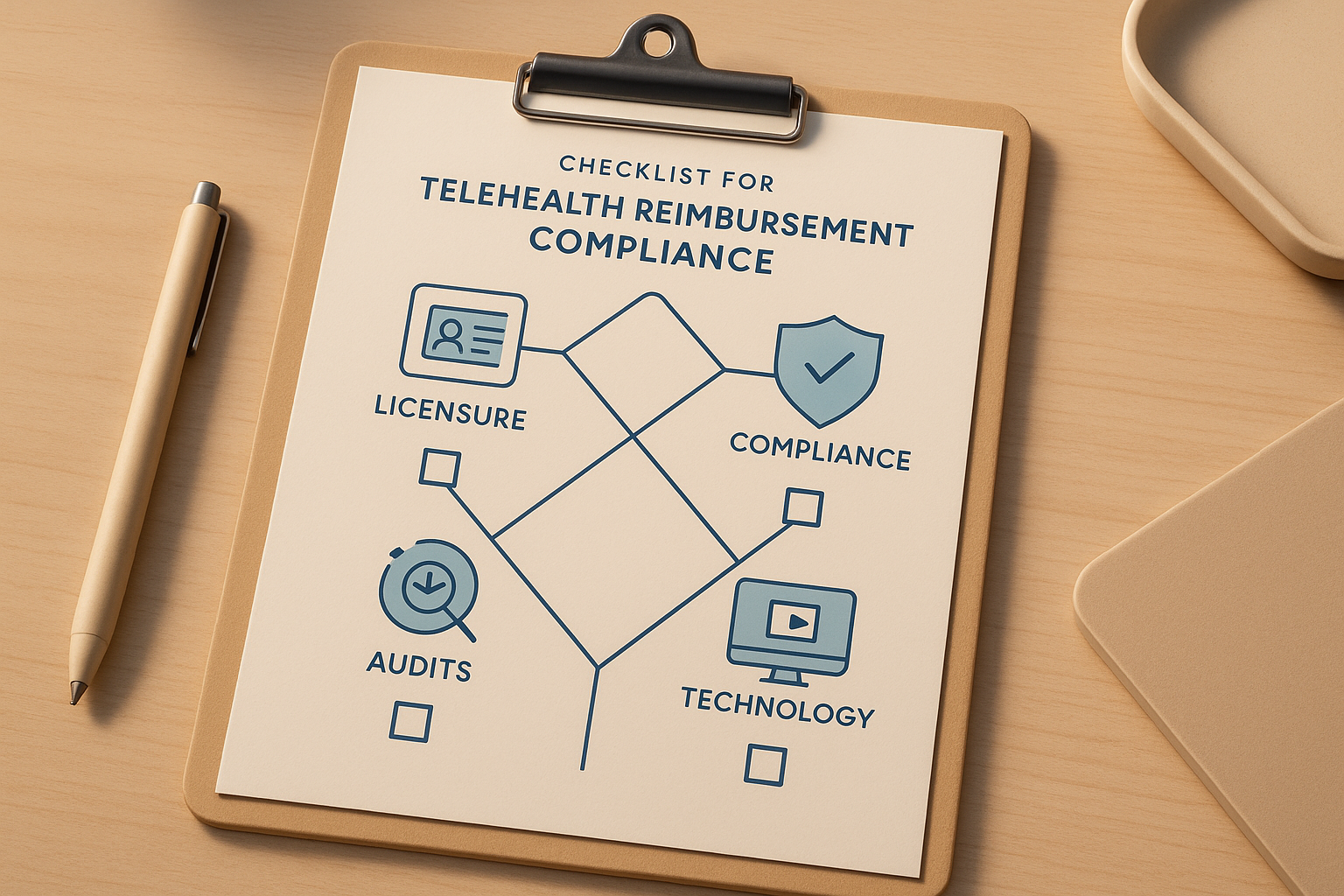

A telehealth reimbursement compliance checklist confirms four things before a virtual visit is billed: the clinician is licensed where the patient is located, the payer covers that service by telehealth, the claim carries the place-of-service code and modifiers the payer asks for, and the note records consent, locations, modality and medical necessity. For Medicare, CMS says the expanded telehealth flexibilities run through December 31, 2027: patients can be anywhere in the United States, including at home, and audio-only visits at home are allowed until then.
Quick reference for Medicare telehealth claims:
- POS 02: telehealth provided other than in the patient's home.
- POS 10: telehealth provided in the patient's home. Since January 1, 2024, Medicare pays home telehealth at the non-facility rate.
- Modifier 95: synchronous audio-video telemedicine. Many commercial and Medicaid payers ask for it; check each payer's policy.
- Modifier 93: synchronous audio-only service. Use it only where the payer allows audio-only.
- Modifiers BB and BC: required by Medicare for telehealth services starting January 1, 2027. BB flags services furnished through a virtual platform the practitioner contracts with or pays for; BC flags telehealth services furnished incident to a practitioner's service. CMS says neither changes payment.
- 98016: brief virtual check-in for an established patient. It replaced HCPCS G2012 in 2025. A check-in is not a telehealth visit.
Sources checked October 14, 2026 · Prepared by Prospyr. No certified-coder or clinician review is claimed. CPT is a registered trademark of the American Medical Association; use the current licensed code set.
1. Confirm licensure and scope
- The clinician generally needs a license in the state where the patient is located during the visit. Ask for the patient's location at every visit, not just at intake.
- Interstate compacts such as the Interstate Medical Licensure Compact and the Nurse Licensure Compact can speed up licensing in member states. They do not replace a license.
- Scope of practice for NPs, PAs and RNs is set by each state. Check it for the service and the state, especially for prescribing.
- Keep one log per clinician: license number, state, expiration date and compact privileges.
2. Check each payer's telehealth policy
Medicare, each state Medicaid program and each commercial plan set their own rules. For every payer you bill, record:
- which codes it covers by telehealth (for Medicare, the Medicare Telehealth Services List)
- allowed modalities: audio-video, audio-only, store-and-forward
- eligible clinician types
- patient-location rules
- required POS codes and modifiers
- prior authorization rules and visit limits
- whether it pays telehealth at the same rate as in-person care
Put this in a one-page sheet per payer, add the date you checked it, and recheck when the payer publishes an update. Medicare changes its telehealth list once a year through the physician fee schedule rule, effective January 1.
Medicare dates to watch
| Rule | Through December 31, 2027 | Starting January 1, 2028 (current law) |
|---|---|---|
| Patient location | Anywhere in the U.S., including home | Generally a medical facility in a rural area, except behavioral health |
| Audio-only at home | Allowed | Behavioral health only, with conditions |
| Practitioner types | Expanded list | PTs, OTs, SLPs and audiologists can no longer bill telehealth |
Congress has extended these dates several times, so confirm them in the CMS Telehealth FAQ before each new year.
Reading about the problem? See how Prospyr solves it in one platform.
Book a Demo3. Code and document every visit
Bill the service code that describes what was done, plus the payer's POS code and modifiers. A telehealth E/M visit is still an E/M visit and needs the same documentation as an in-person one.
Each telehealth note should record:
- the patient's consent to telehealth
- the patient's location (city and state) and the clinician's location
- the modality (audio-video or audio-only) and why audio-only was used, if it was
- start and stop times when the code is time-based
- the history, findings, assessment and plan that support the code and diagnosis
- orders, prescriptions, referrals and follow-up
4. Separate medical visits from cosmetic consults
Medicare does not pay for cosmetic surgery or services connected with it, and most commercial plans exclude cosmetic care. A virtual consult about Botox for wrinkles or filler options is self-pay. A virtual visit for a diagnosed medical condition, such as acne or a post-procedure wound problem, may be billable if the payer covers it and the note supports it. Record which one the visit was.
Weight-management programs need the same care. For example, Medicare covers intensive behavioral therapy for obesity only for patients with a BMI of 30 or more, furnished by a primary care physician or practitioner in a primary care setting (NCD 210.12). Commercial coverage varies by plan. Check the payer before you build a program around insurance billing.
5. Use a HIPAA-compliant platform with a BAA
HHS's COVID-19 enforcement discretion for consumer video apps ended with a transition period that closed on August 9, 2023. Telehealth now has to meet the HIPAA Privacy and Security Rules like any other care. Use a video platform whose vendor signs a business associate agreement (BAA), and limit access to the team members who need it.
6. Train the team and audit
- Train schedulers to ask for the patient's location and confirm telehealth coverage before booking.
- Give clinicians a note template with the consent, location, modality and time fields above.
- Pull a sample of telehealth visits on a set schedule. Check each against the payer sheet: covered code, correct POS and modifiers, complete note.
- Review telehealth denials by payer and reason, and update the payer sheet when you find a pattern.
Where Prospyr fits
Prospyr does not submit insurance claims. It supports charting, digital intake, telehealth visits, inventory and practice operations, so consent and visit details can live in the chart. Practices that bill insurance heavily need a separate claims solution.
Sources
- CMS Telehealth FAQ, updated October 2026
- CMS: Medicare telehealth coverage and services list
- CMS MLN901705: Telehealth & Remote Monitoring (December 2025)
- ACP: Video visits billing and coding (98016 replacing G2012)
- CMS NCD 210.12: Intensive Behavioral Therapy for Obesity
- Goodwin: end of the HIPAA telehealth enforcement discretion transition period